
Live band, venue & technical setup: what to clarify before booking
A live band works best when the music, the running order and the room have been thought through together – at a wedding just as much as at a ball, a corporate event or a gala. Power, space, setup time, volume limits, soundcheck, outdoor conditions and any second performance areas are all worth settling early.
This planning guide sets out the technical questions organisers, event planners, wedding planners, couples and venues do well to put to the band before booking, or at the latest once the detailed planning starts. Much of it depends on the setting: a palais in Vienna makes quite different demands from a winery in Lower Austria, or from a celebration by Lake Neusiedl in Burgenland.
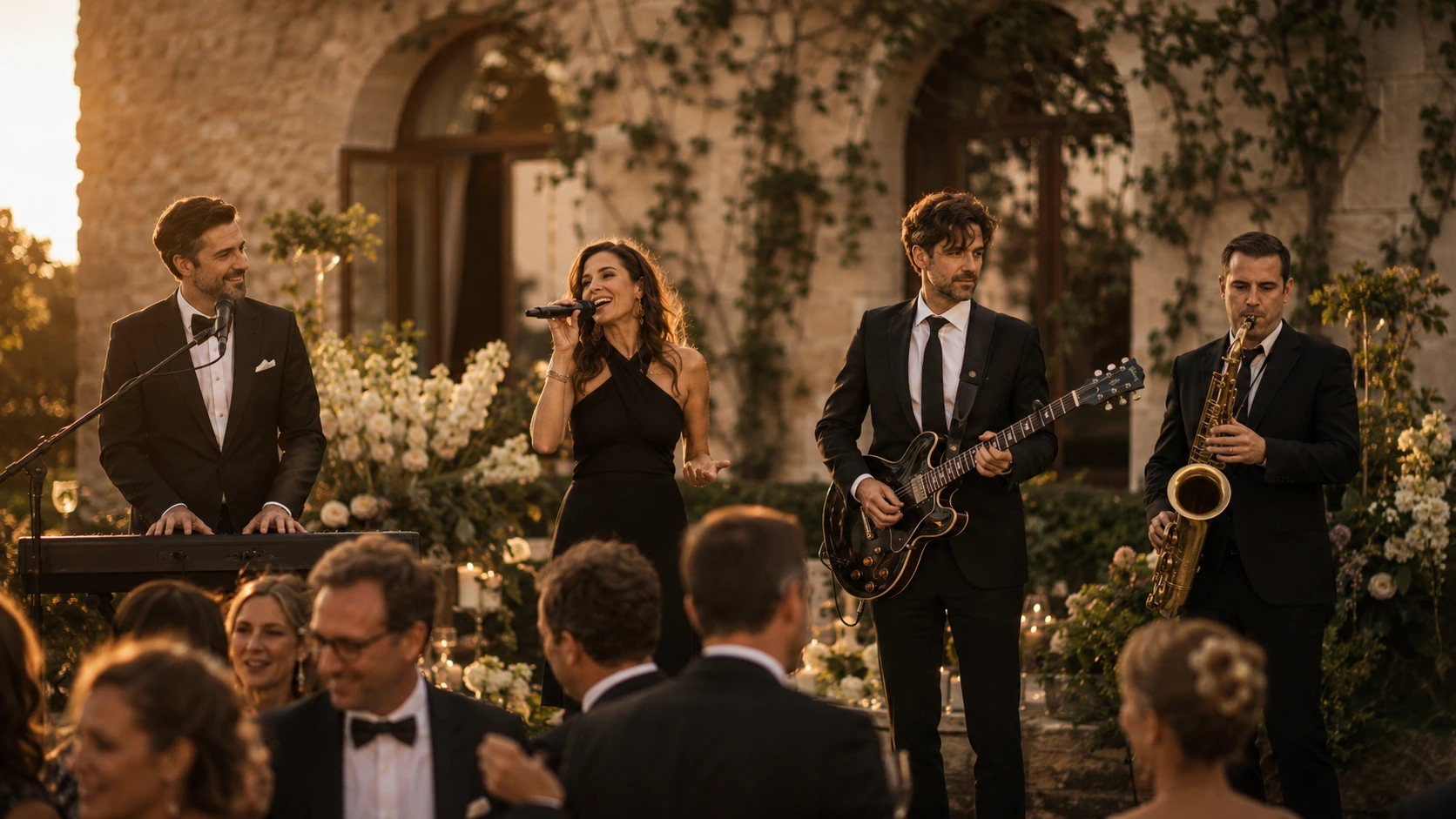
Short answer
Go through the following with the venue before booking a live band: power supply, space requirements, stage or performance area, access, load-in route, parking, setup time, soundcheck, volume limits, curfew, outdoor conditions and multiple performance areas. The Jetset Society brings its own sound and lighting system and settles these points with the venue; as a rule of thumb, allow around 10 m² of performance area for 4 musicians – smaller areas work too.
Why venue and technical setup matter before booking
Plenty of these questions look like small print, yet they shape how the day of the event actually runs. A late slot for setting up, an unclear power supply or second performance areas nobody has prepared can all create stress that need never have arisen.
1. Space, stage and performance area
How large is the lineup?
A smaller lineup such as a quartet takes up less room than a larger event band with several vocalists, horns and the extra equipment that comes with them. It is worth matching the planned size of the band to the size of the room.
Is there a stage?
A stage is not always necessary; a clear, level and safe performance area is. At balls, galas and larger weddings, an elevated stage can make a noticeable difference.
Where is the dance floor?
Ideally band, speakers and dance floor form one connected area. Too much distance between the musicians and the guests takes energy out of the room, while a cramped area can restrict both the equipment and the freedom to move.
At The Jetset Society a suitable lineup is chosen not by musical taste alone, but by room size, stage, number of guests, schedule, the effect you are after and the budget you have in mind.
2. Power, cable routes and safety
Which power sockets are available?
The venue should be able to say where the sockets sit and how the circuits are divided. Larger sound or lighting setups may call for circuits of their own.
Are cable routes safe?
Cables should never cross guest paths, service routes or dance floors. Safe cable runs with no trip hazards matter most outdoors and wherever the band plays in more than one performance area.
Who is the technical contact?
One named contact at the venue makes short work of questions about power, in-house sound, lighting, microphones for speeches and setup times.
Is there in-house equipment?
Where a venue offers sound or lighting of its own, it is worth establishing early whether, and for what, it will be needed during speeches, dinner and the party. For the live band we recommend our own system; the venue’s in-house equipment is used only if you specifically ask for it. As a rule the band mixes its own sound; where a sound company is booked as well, a dedicated sound engineer takes over.
Power, performance area, setup time, volume, access and the venue contact can all be agreed in advance with the venue or the planning team, because The Jetset Society handles these points from the start.
3. Setup, soundcheck, access and parking
When can setup start?
The band needs room in the schedule for unloading, setting up, cabling, the soundcheck and making the stage look presentable; the exact slot is fixed together with the venue and the organisers.
Is a soundcheck possible?
A soundcheck is what produces balanced sound at a sensible volume. If the room is already in use for dinner, it needs planning with particular care.
How do access and parking work?
Instruments and technical equipment do not travel like hand luggage. A short load-in route, workable access and somewhere to park save time and take risk out of the day.
Depending on the shape of the event, The Jetset Society accounts for sound, lighting, setup, soundcheck, teardown and technical requirements in the quotation and the detailed planning; that professional technical planning is part of the overall service.
4. Volume limits, curfew and neighbours
Are there volume limits?
Some venues work with decibel limits, limiters (devices that hold the volume below a set level, in some venues by cutting the power) or set rules about music after a certain hour. These are details to have in hand before the running order is finalised.
What time is the curfew?
Where only quiet music is permitted after 11 pm or midnight, the evening is planned around that, so the strongest live-band stretch can start earlier.
What are the room acoustics like?
High ceilings, glass, stone floors and vaulted rooms behave quite differently from a well-dampened ballroom. A professional band takes the acoustics of the room, and the volume that suits it, into its technical planning.
Are there hotel guests or neighbours?
At hotels, city venues and wineries there may be neighbours or other guests to take into account. Better to know that in advance than to discover it in the middle of the party.
5. Outdoors, ceremony, agape and second sound system
Can the band perform outdoors?
Yes. In fine weather the band plays outdoors without any difficulty. As soon as rain, strong sun or wind come into play, the performance area needs a roof or other weather protection. Power, level ground, safe cable routes and a bad-weather plan are needed as well.
Does the ceremony need its own system?
Where the ceremony or the agape (the Austrian post-ceremony drinks) is held away from the party area, a small second sound system or a mobile setup can be useful. If the drinks reception is held outdoors (in a palace courtyard or on a lawn, say) and the party follows indoors, the band will often need a compact second sound system. Raise this point early on when booking. Whether a well-planned changeover does the job instead comes down to distance, schedule and timings.
How long do changeovers take?
Leave enough time between the ceremony, the reception, dinner and party. Without a second setup, a changeover makes more of a dent in the schedule.
Are speeches or an MC planned?
Speeches (including those by the best man and maid of honour), an MC or programme items may require wireless microphones or extra inputs. Worth agreeing in advance.
6. What each type of event adds
Ceremony, the agape and party often take place in different spots. Changeovers, routes and, where needed, a second sound system are built into the plan for the day.
Opening, ballroom dances and midnight show all run on clear cues. Stage, microphones for the MC and the curfew are settled with the venue early on.
Speeches, awards and entrances depend on well-judged transitions. Extra microphones and a clear schedule agreed with the host and the technical team matter most here.
Presentations, awards and words of thanks all go through the PA. Volume, breaks and transitions are matched to the programme.
The stand itself, together with the fair’s rules on volume and setup times, sets the frame. Equipment is scaled to the space and the setup stays compact.
Here volume, service and the flow of guests come first. The technical setup stays deliberately compact so that conversation stays in the foreground.
What the band needs on site
Power supply
A standard socket near the performance area is enough. Two or three make life easier, though they are not a condition. Power is the one technical essential that genuinely has to be in place on the day: it feeds the instruments, the PA and the lighting, and the whole evening rests on it. Indoors that is practically always the case; for a garden, a marquee or a courtyard we settle it with the venue in good time.
Performance area
Level and dry, and covered outdoors whenever the weather is a risk. As a rule of thumb, allow about 4 m² for a duo and roughly 3 m² for each additional musician; smaller areas work too.
Load-in and parking
A short run from the loading area to the stage, and a parking space close by, keep the setup calm and on schedule.
Time slot for setup and soundcheck
Setup and soundcheck together take one to two hours, depending on access on site, lineup size and the scope of the equipment. Allow roughly an hour and a half for the teardown after the last song, again depending on how much of the equipment is ours.
Catering
A meal for the musicians is customary at events and is agreed with the organisers. As a rule that means at least one hot main course and soft drinks, frequently with wine, beer and coffee alongside. We do ask for it. Where the band eats is settled case by case.
How many people arrive
The number of people who arrive is exactly the number in the lineup you have booked: book six musicians and six people come through the door. Additional crew travel with the band only where that has been agreed, so seating, catering and parking can be planned on that basis.
On-site contact
One point of contact for technical questions, timings and running order keeps coordination on the day simple.
Venue and technical checklist
- Which lineup and performance area are planned?
- Is there a stage, dance floor and enough space for equipment?
- Where are the power sockets and which circuits are available?
- When can the band set up and when is soundcheck possible?
- How do access, load-in route, lift, stairs and parking work?
- Are there volume limits, limiters, curfew or neighbour restrictions?
- Is any part of the wedding outdoors and is there a bad-weather plan?
- Are there separate performance areas for the ceremony, the agape, dinner and party?
- Who is the technical contact at the venue on the event day?
- Are microphones needed for speeches, the ceremony or an MC?
Next steps
A checklist covering lineup, repertoire, pricing, contract and peace of mind.
How it runs, from enquiry and quotation through booking to technical setup and soundcheck.
Song choice, timing and the move into the party, folded into the musical and technical planning – the band plays the first dance live, or plays the recording through its own PA.
Planning for several performance areas, a second sound system, volume and the phases of the event.
The full overview: event phases, schedule, pricing and enquiry.
By Thomas Gindl – bandleader of The Jetset Society
Frequently asked questions about venue and technical setup
What should be clarified with the venue before booking a live band?
Important points include power, space, stage or performance area, access, load-in route, parking, setup time, soundcheck, volume limits and any sound limiter installed in the room, curfew, outdoor conditions, venue contact and possible second performance areas.
How much space does a wedding band need?
As a rule of thumb, allow about 4 m² of space for a duo and roughly 3 m² for each additional musician – around 7 m² for a trio, 10 m² for a quartet and about 31 m² for 11 musicians. Smaller areas work too: at weddings in particular, the band regularly plays on compact stages. Beyond that, it depends on the lineup: a smaller band needs less space than a larger lineup with several vocalists, guitar or horns and additional technical setup. A safe performance area, power, monitoring and room to move all matter. You can estimate the space for a specific lineup with the space calculator.
Can a live band perform outdoors?
Yes. In fine weather the band plays outdoors without any difficulty. As soon as rain, strong sun or wind come into play, the performance area needs a roof or other weather protection so that instruments and equipment stay dry and shaded. Level ground, power and safe cable routes are needed as well, and an indoor fallback area is agreed in advance in case the weather turns. If an event has to be called off because of rain once the band is already on site, the agreed fee remains payable; everything else is settled at the time of booking.
Do we need a second sound system for ceremony and party?
Not always. If the ceremony, the agape or the reception is held away from the later party, a second or mobile sound system can be useful. Often, though, a well-planned changeover does the job just as well; it comes down to distance, schedule and timings. Without a second setup, a changeover makes more of a dent in the schedule, so leave enough time between the ceremony, the reception, dinner and party. Either way, it is best settled early, so that changeovers do not disrupt the day.
Why is a soundcheck important?
A soundcheck means balanced sound, suitable volume and less stress during the event. It should be coordinated with setup time and the venue schedule. Setup and soundcheck together take one to two hours, depending on the load-in routes on site, the size of the lineup and how much equipment is involved.