
Which band size fits your event?
Lineups of 4 to 11 musicians, and from 3 for jazz, lounge and dinner: guest numbers alone will not tell you the right size for your live band.
This guide sets out when a jazz, lounge or dinner setup from 3 musicians is all you need, when a flexible live band from 4 musicians is the ideal answer, which lineup we recommend for which occasion, and when a larger lineup with several voices or horns makes the stronger impression.
Band size at a glance
Recommendations by occasion
For weddings we recommend 5 to 7 musicians, for corporate events 5 to 8, for balls 6 to 11 and for galas 5 to 10; we can play any occasion with any lineup from 4 to 11 musicians. A larger lineup brings more voices, horns and a fuller live sound – above all at balls, galas and events with a big stage.
Several musical phases
For many weddings, corporate events, parties and occasions that run through several musical phases – from dinner through to the dance floor later on – a lineup within the range we recommend for the occasion is a strong all-rounder.
Smaller lineups from 3 musicians
The right choice wherever elegance and easy conversation count for more than a big stage presence. What sets the size is the style of music and the effect you are after: quieter, conversation-friendly formats – jazz, lounge, dinner, reception or the agape (the Austrian post-ceremony drinks) – are possible from 3 musicians, and a ceremony from 2. As soon as vocals, several musical phases and a later dance floor come into it, a lineup from 4 musicians is the better fit.
The most important answer first
A live band playing to 80 guests can come across quite differently in a small room than the same lineup does with 80 guests in a large hall. Equally, a larger band at a gala can play with control and elegance and without being too loud, provided the technical setup, the running order and the room are planned to match.
The questions that decide it: should the music simply accompany the evening or visibly shape it? Is there a stage? Will people dance? Does the evening include dinner, a reception, programme items, a first dance, awards or a party phase? And what impression should it leave in the end?
That is why The Jetset Society works with flexible live lineups. Some occasions are well served by a smaller setup. For others, a larger live band is the stronger choice.
Build your lineup
Which lineup creates which effect?
3 musicians: jazz, lounge and dinner
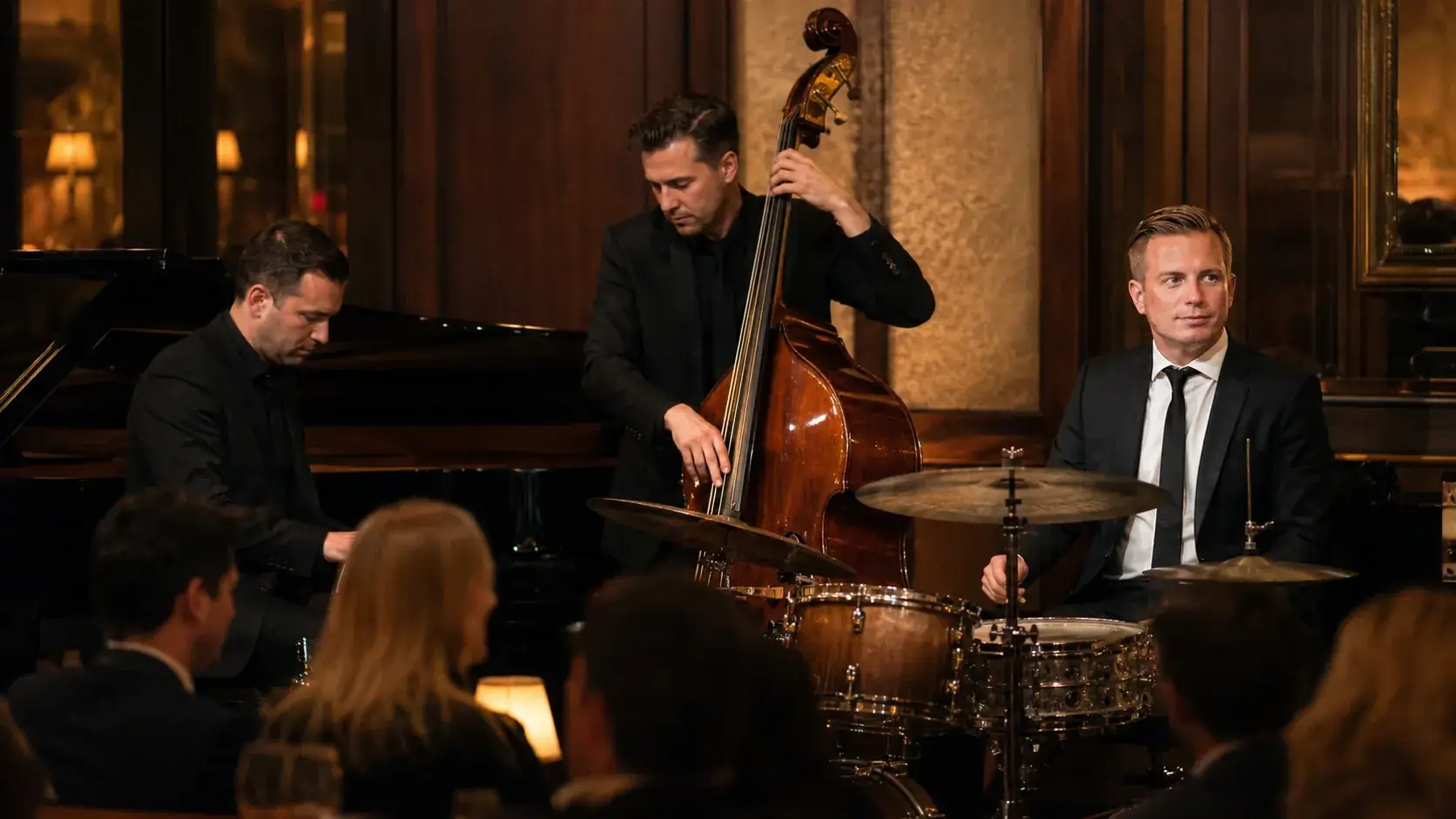
Setups from 3 musicians suit quieter, conversation-friendly formats – hotel events, business dinners, jazz brunches, receptions with lounge music, the agape, ceremonies and elegant background music. Style of music and intended effect are what count here: wherever jazz, lounge or dinner music sets the tone, a trio already fills the room. Lineups of this size are space-saving, easy to talk over and stylish.
Quartet or quintet live band
As a quartet or quintet, the band already covers vocals, rhythm, harmony and several musical phases, and can carry a dinner-plus-party concept too.
Flexible event lineup up to the big stage
Each additional musician adds something: more tonal colour, more voices, stronger dynamics and more live energy – without the lineup necessarily outgrowing the room or the budget. With several voices and horns the band becomes a live band for the big stage – at balls, galas and occasions built around a strong stage presence.
What each lineup is made up of and how much space it requires is set out on the Lineups page, and the lineup we recommend for each occasion is in the table “Guidance by event type” on the same page.
Which band size fits which number of guests?
Which band size suits a given number of guests depends mainly on the occasion: for weddings we recommend 5 to 7 musicians, for corporate events 5 to 8, for parties 5 to 9, for galas 5 to 10 and for balls 6 to 11. With more guests and a larger room, the upper end of that range is usually the better choice; in principle, any lineup from 4 to 11 musicians is possible.
Up to about 50 guests
For smaller gatherings – an elegant private celebration, say, or a wedding or corporate party on a compact scale – the lower end of the recommended range for the occasion is often enough. Quieter, conversation-friendly formats – jazz, lounge, dinner, reception, the agape or ceremony – also work with smaller setups. Where there is serious dancing planned for later, a slightly larger lineup can be worth considering.
About 50–120 guests
For many weddings, corporate events and private occasions, a live band of the size we recommend for the occasion works very well. The exact size turns on whether the band is there to accompany the evening or to carry the later party as well.
From about 120 guests
In larger rooms, and at balls, galas and corporate events on a grand scale, a lineup at the upper end of the recommended range for the occasion can make a good deal more impact – especially on big stages and busy dance floors.
Band size by event type
A lineup of 5 to 7 musicians is often ideal across reception, dinner, first dance and party; for the ceremony itself we recommend 2 to 4 musicians. Smaller setups also suit dinner, and a lineup from 4 musicians carries the first dance and party just as well; larger lineups bring more party and show energy.
A smaller setup can be enough for networking and business dinners. For staff parties, summer parties, client evenings or corporate events on a grand scale, a lineup of 5 to 8 musicians is often more effective; these occasions are equally possible from 4 musicians. The Music for corporate events page explains how to shape the musical arc.
A smaller lineup can feel elegant for reception and dinner; for the year-end moment, speeches and the party afterwards, a live band of 5 to 8 musicians often makes more sense. Music for Christmas parties goes into the detail.
For New Year’s Eve we recommend 6 to 10 musicians, including a horn section – the most popular choice; any lineup from 4 to 11 musicians is possible. A New Year’s Eve celebration calls for festive music over dinner and for party and pop hits that run on past midnight.
Balls thrive on musical range, danceability and clear stage presence. For balls we recommend 6 to 11 musicians; the bigger the ball, the more the upper end of that range makes sense – especially where ballroom standards, contemporary songs and party sets are combined. The ball band checklist offers a detailed planning aid.
At a gala, what counts is elegance, timing, controlled volume and stage impact. A larger lineup can frame award moments, dinner, show segments and the later dance floor to considerably greater effect.
For private celebrations and birthdays, the size depends heavily on the room, guest numbers and the dance-floor energy you are after. A smaller lineup can be elegant; a larger one comes across as stronger and more versatile.
For trade fair events we recommend 4 musicians on the stand and 6 to 8, including a horn section, in the evening or at the trade fair party – the most popular choice. On the stand, what counts is understated lounge music at a volume that leaves room for conversation; in the evening, it is the party on the dance floor. For stand parties and evening events at trade fairs, lineups from 4 to 11 musicians are possible, depending on space and the number of guests.
Smaller lineups from 3 musicians are often the best answer for hotels, dinners, receptions and lounge settings. They make live music possible at a controlled volume and with less space required.
When do horns make sense?
Horns come into their own with soul, disco, swing, gala moments, big openings and high-energy party sets. They generate more live punch, more colour and more stage impact. At galas, balls, larger corporate events and weddings in particular, that can be very worthwhile.
For dinner, lounge music, small rooms or event phases built around conversation, a smaller lineup is often the more elegant option. So the question is not “are horns always better?” but “what effect should this part of the evening have?”
Technical setup, stage and room size
Space & stage
A smaller lineup can often be placed flexibly within the room. Larger lineups need more stage, better sightlines, sensible walkways and enough space for instruments and monitoring.
Power & technical setup
The larger the lineup, the more weight falls on power supply, setup time, technical planning and coordination with the venue or the production team. These points are best settled early.
Volume & acoustics
A professional band plans volume around the phase of the event. Reception, dinner and networking call for a different dynamic from a dance floor, a ball or a large party.
Decision by musical phase
Reception, agape & networking
For the reception and the agape we recommend 4 to 6 musicians; an instrumental jazz trio is also possible. During these phases and while guests network, the music should feel present and elegant without dominating the room. Conversation should stay easy.
Dinner and quieter programme items
Dinner music needs sound quality, timing and a feel for volume. A smaller formation or a pared-back playing style can come across as more stylish here than too much stage energy.
Opening, awards, first dance
The special moments repay a lineup that can carry the dramatic arc: a clear voice, good dynamics, well-judged arrangements and enough musical presence.
Dance floor and party
Where the band is meant to carry the party, the upper end of the recommended range for the occasion is often the stronger option. More voices, more rhythm and, where wanted, horns create a different energy on the dance floor.
Band size and how pricing works
More musicians mean more artistry on stage, more preparation, more coordination, more technical requirements and often more setup time. At the same time, a larger lineup can make an event considerably more moving and give it more stage presence.
Alongside band size, the quote also takes in performance time, venue, travel, setup, technical equipment, room size, event duration, the musical phases you want covered and the running order. That is precisely why The Jetset Society gives price guidance and puts together tailored quotes.
There is more on how pricing works on the Pricing page. For weddings, What does a wedding band cost? answers the cost question with guide figures for each lineup size.
Quick comparison table
| Situation | Typical number of guests | Commonly chosen lineup | Effect | Volume | Emphasis on dancing |
|---|---|---|---|---|---|
| Ceremony | up to approx. 100 guests | 2 to 4 musicians | Elegant, flexible, conversation-friendly | Conversation level | low |
| Agape, reception | up to approx. 100 guests | 4 to 6 musicians | Elegant, flexible, conversation-friendly | Conversation level | low |
| Dinner, business dinner, lounge | up to approx. 100 guests | 3 to 5 musicians | Stylish, subtle | Conversation level | low |
| Wedding with dinner and party | approx. 60–150 guests | 5 to 7 musicians | Versatile, emotional, danceable | Conversation to dancing | medium to high |
| Corporate event with a later dance floor | approx. 80–200 guests | 5 to 8 musicians | Professional, present, dynamic | Conversation to dancing | medium to high |
| Ball | approx. 150 guests and up | 6 to 11 musicians | Elegant and danceable through to prestigious, powerful and stage-focused | Conversation to dancing level | medium to high |
| Gala | approx. 150 guests and up | 5 to 10 musicians | Elegant and danceable through to prestigious, powerful and stage-focused | Conversation to dancing level | medium to high |
Bookable lineup sizes: 4 to 11 musicians, and 3 for jazz, lounge and dinner. The table sets out commonly chosen formations, not requirements: we can play any occasion with any lineup from 4 to 11 musicians. With more guests, a larger venue or more sound presence in mind, the upper end of the range for that occasion is usually the better choice. Our recommendations: 5 to 7 musicians for a wedding, 5 to 8 for a corporate event, 6 to 11 for a ball, 5 to 9 for a party, and 5 to 10 for a gala.
Further decision guides
The companion guide explains when live music, a DJ, a playlist or a combination of them makes sense – and how the musical arc can be planned for a wedding, corporate event, gala, ball or party.
The planning process, from enquiry, quote and booking through to detailed coordination, technical setup, soundcheck and performance.
For prestigious gala dinners, award shows, charity events and corporate galas.
For corporate events, client events, product presentations, galas and other evening occasions.
Which lineup fits your event?
Tell us the date, venue, number of guests, occasion, musical phases and the effect you have in mind. We will recommend a lineup to match – anything from a jazz trio to a live band of 11 musicians.
By Thomas Gindl – bandleader of The Jetset Society
Frequently asked questions about band size
Which band size fits a wedding?
For many weddings, a lineup of 5 to 7 musicians is especially useful because it can cover reception, dinner, first dance and party flexibly. Smaller setups fit ceremonies, the agape or dinner, and a lineup from 4 musicians carries the first dance and party just as well; larger lineups are suitable when stronger stage impact, several vocalists or horns are desired.
Which band size fits around 100 guests?
For around 100 guests, the right lineup depends mainly on the occasion: for weddings we recommend 5 to 7 musicians, for corporate events 5 to 8, for parties 5 to 9, for galas 5 to 10 and for balls 6 to 11. With more guests and a larger room, the upper end of that range is usually the better choice; in principle, any lineup from 4 to 11 musicians is possible. Room size, stage, schedule, event phases and the desired live impact are just as important.
Does a corporate event need a large band?
Not always. For corporate events we recommend 5 to 8 musicians – the most popular choice – ideally with horns. A corporate event often pairs polished music for the reception, networking and dinner with the party and pop hits for the dance floor later on. With more musicians, both sound fuller and rounder, and the parts of a song stand out more clearly from one another. We can play any corporate event with any lineup from 4 to 11 musicians. A smaller lineup can be ideal for receptions, networking and dinner. For corporate events on a grand scale, gala dinners, award settings or a later dance floor, a larger lineup can create more impact.
When are horns worth adding?
Horns are especially useful when you want soul, disco, gala moments or a full dance floor. They add colour and stage impact, but they are not necessary for every dinner, lounge or small-event setting.
What is the smallest useful lineup?
For jazz, lounge and dinner settings, The Jetset Society can play smaller setups from 3 musicians, and a wedding ceremony from 2. For classic event formats with vocals, several event phases and a later party, a lineup from 4 musicians is usually more useful.
Why choose a larger lineup when any size can play any occasion?
With the core lineup of 4 musicians – keyboard, bass, drums and vocals – in principle every song on the repertoire list can be played. Each additional musician adds something: a second voice, guitar or horns. With 5 musicians you choose one of these; from 6, two can be combined – trumpet and saxophone, for example. The song stays the same; what grows is the tonal colour and the stage presence. It does not automatically get any louder. Musically, a larger lineup sounds fuller and rounder, and the parts of a song stand out more clearly from one another.
Is a larger band automatically louder?
No. A larger band does not automatically mean more volume. It mainly provides more colours, vocalists, dynamics and stage impact. Professional volume planning depends on the room, occasion, audience and event phase.
How much space does the band need?
As a rule of thumb for the space The Jetset Society needs, allow about 4 m² for a duo and roughly 3 m² for each additional musician – around 7 m² for a trio, 10 m² for a quartet and about 31 m² for 11 musicians. Smaller areas work too: at weddings in particular, the band regularly plays on compact stages. The exact space required depends on the lineup, technical setup and planned schedule. A smaller lineup needs less space than a larger lineup with several vocalists, horns or additional technical equipment. If the venue has already been selected, details about stage area, power, access and existing equipment are very helpful; you can also find guidance under Event partners & venues. You can estimate the space for a specific lineup with the space calculator.
How does band size affect pricing?
Band size is one of the key pricing factors because several professional musicians, technical setup, preparation, setup time, travel and performance time need to be considered. This is why The Jetset Society prepares tailored quotes based on lineup, performance time, technical setup, venue, travel and schedule.
Can the musical impact grow during the evening?
Yes. A good musical arc can start subtly and build more energy later. Depending on the lineup, reception, dinner, programme items, opening moments, dance floor and party can become one coherent musical flow.
How do I find the right lineup for my event?
The best approach is to send the date, venue, number of guests, occasion, event phases, schedule, room size and the impact you want. Based on this, The Jetset Society can recommend which lineup – from a jazz trio to a live band of 11 musicians – is the best fit.