
Wedding ceremony, reception & dinner music with a live band
A wedding day is made of very different musical moments. Ceremony music – whether civil, humanist or church – should carry the emotion. Reception music creates atmosphere, and dinner music stays conversation-friendly. The later transition leads naturally into first dance and party.
For an overview of the band, see the wedding band page.
This guide explains how to plan live music for ceremony, drinks reception and dinner. It covers the right lineup, volume, song requests, technical setup and transitions. Where each phase takes place shapes the music as well – a ceremony in the park, a reception in the courtyard, dinner in the hall. Regional overviews are available for Vienna, Lower Austria and Burgenland.
Short answer
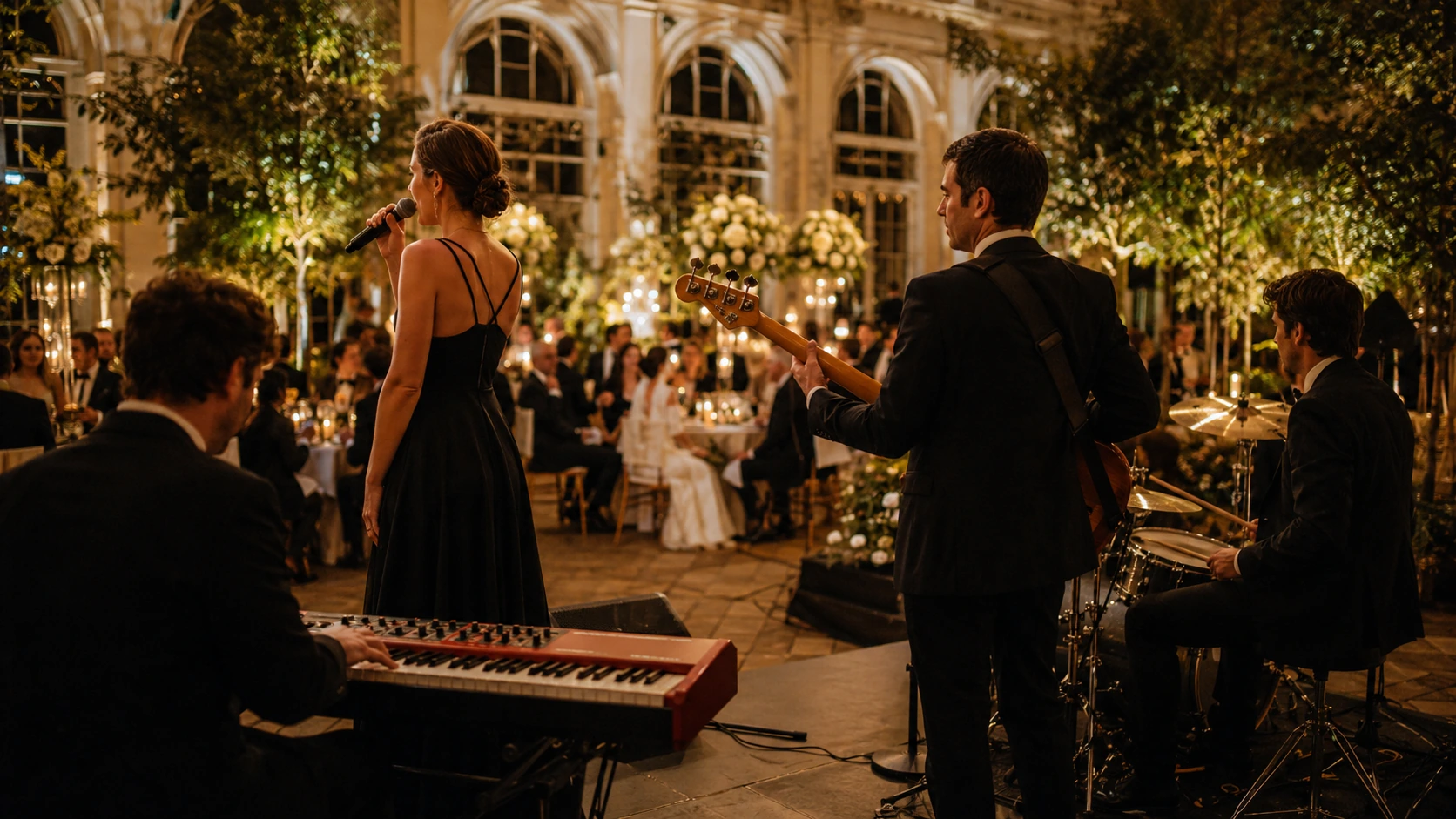
Ceremony, drinks reception and dinner music are best planned as three distinct phases with different functions: emotion, arrival, conversation-friendly atmosphere, subtle presence and a smooth transition into first dance or party. The ceremony music carries the most emotional moment of the day. The musical setting for ceremony and reception – classic ceremony music from the processional to the recessional – is usually provided by lineups of three or more musicians; for the ceremony itself, a duo is also available on request.
Why it matters
Wedding music works better when the evening has a clear musical arc. The band does more than play songs: it shapes energy, volume and lineup around the schedule.
1. Music for the ceremony
Entrance and exit
Entrance and exit are the ceremony’s clearest musical moments. Clarify early which version, tempo and length you want. Also clarify whether the song should be live, instrumental or with vocals.
Ring exchange, signing and rituals
Musical moments during the ceremony should stay short and understated. Pared-back arrangements can support the ceremony without interrupting it.
A song outside the repertoire list
A personal favourite often sits outside the repertoire list. We are happy to learn such a song specially for you and arrange it for your booked lineup, with the extra preparation reflected in your quote. Raise important ceremony songs early, so there is plenty of time to settle version, key, length and arrangement.
Civil ceremony
At the registry office, the musical programme is usually compact. It covers the entrance, one or two pieces during the ceremony, and the exit. Small, subtle lineups work particularly well here.
Humanist ceremony
For humanist ceremonies, the music is flexibly tailored to the running order, the speakers and the venue. Indoor or outdoor acoustics are factored into the planning.
Church ceremony
In church, room acoustics and the order of the ceremony matter most. Musical moments such as the entrance, the exchange of rings and the exit are planned together with the officiant.
Wedding songs for the ceremony: processional and recessional
Searching for wedding songs usually means searching for three moments: the entrance, the quiet minutes during the ceremony and the exit. These examples have proven themselves live:
For the entrance (processional): Perfect (Ed Sheeran) · Can’t Help Falling in Love (Elvis Presley) · At Last (Etta James) · All of Me (John Legend) · Make You Feel My Love (Bob Dylan) – tender and emotional, sung or instrumental.
During the ceremony – for the ring exchange and the signing: Thinking Out Loud (Ed Sheeran) · Love Me Tender (Elvis Presley) · Hallelujah (Leonard Cohen) – or understated instrumentals such as Moon River and As Time Goes By.
For the exit (recessional): Marry You (Bruno Mars) · Ain’t No Mountain High Enough (as a duet) · Happy (Pharrell Williams) · Lovely Day (Bill Withers) – now the music gets to shine.
Together they turn individual wedding songs into one musical arc – from the first note of the entrance to the applause at the exit. All examples come from the repertoire list, which can be filtered by title, artist, dance style and genre.
2. Music for the drinks reception
Atmosphere, not show
Reception music should open the room: elegant, positive and welcoming. It may be noticeable, but it should never drown out conversations, congratulations or first encounters. The result: a stylish backdrop that welcomes guests as they arrive.
Suitable styles
Depending on the venue, soul, pop, jazz and lounge can work very well. So can acoustic versions or subtle saxophone, piano, guitar and vocal settings.
Outdoor and second setup
If the reception takes place outdoors or away from the dinner and party area, a second sound system or separate setup may be useful.
Jazz band for the reception: trio and quartet
For the drinks reception and aperitif, a small jazz band is the proven solution. A jazz trio (e.g. piano, double bass, drums) or jazz quartet (with vocals or saxophone added) plays jazz standards, bossa nova, swing and lounge or chillout versions of well-known pop songs. The sound is noticeably elegant, yet never loud enough to drown out congratulations and conversations.
What the music for a wedding day costs is driven above all by lineup size, performance time, date, the scale of the technical setup and the venue. Up-to-date pricing guidance is on our pricing page.
More on styles, lineups and references: Jazz band & lounge music · Wedding band · Lineups
3. Dinner music: elegant and conversation-friendly
Music that allows conversation
Dinner music should support the room without becoming the main attraction. Guests should be able to eat, talk, listen to speeches and still feel the atmosphere of live music. This is the part of the evening where The Jetset Society is most often booked as a dinner band: a smaller lineup, a calmer repertoire and plenty of room for conversation.
Speeches and key moments in the programme
Speeches, presentations or surprises need clear breaks, microphones and coordination between the band, the MC and the venue.
Musical build-up
Dinner can start calmly and grow livelier towards the end, so the transition into first dance and party feels natural.
4. Which lineup fits which phase?
Smaller, subtle settings
Ceremony, reception and dinner can work beautifully with stripped-back jazz, lounge or acoustic settings – also unplugged. They feel elegant, intimate and flexible. For the ceremony itself, a duo is also possible on request – for example a wedding singer with keyboard, or two string players – subtle and focused entirely on the moment. Pure string lineups of three to five players are also possible, for example a string trio or a string quartet.
Medium and large live band lineups
If dinner, first dance and party should form one musical concept, a flexible live band lineup is useful. Larger lineups bring more vocalists, dynamics and stage presence later in the evening.
More guidance: Which band size fits? and Lineups.
5. Technical setup, performance areas and transitions
Multiple performance areas
Ceremony, reception, dinner and party often do not happen in exactly the same place. This affects setup time, changeovers, access, power, volume and second sound systems.
Keep the schedule realistic
If there is little time between ceremony, reception, dinner and party, the technical concept should be clarified early.
Transition into the party
The musical arc should not stop at dinner. Plan the first dance, the first party song and the opening of the dance floor as one continuous flow.
For technical details, see Live band venue & technical setup.
Checklist: ceremony, reception & dinner
- Which event phases should be covered live?
- Which songs are important for entrance, ring exchange, signing or exit?
- Are there links to the preferred versions?
- Is the ceremony outdoors, in church, at a registry office or at the venue?
- Is the reception in the same area as dinner or party?
- What volume is appropriate for reception and dinner?
- Are there speeches or programme items during dinner?
- Are microphones needed for speeches?
- Is a second sound system or second setup useful?
- How should the transition into first dance and party work?
How The Jetset Society plans these phases
Musical arc
We treat the wedding as one full arc. It has an emotional beginning, an elegant reception, a conversation-friendly dinner and a clear build-up towards the dance floor.
Flexible lineup
Depending on the setting, smaller lineups, medium band formats or larger live bands can be useful. Venue, schedule, number of guests and the atmosphere you have in mind define the best setup.
Venue coordination
During detailed planning, we cover multiple areas, outdoor setups, volume, microphones, technical setup and timing.
Next steps
The compact service page for ceremony, reception, dinner, first dance and party.
The full overview for schedule, lineup, technical setup, pricing and enquiry.
From enquiry, quote and booking to technical setup and soundcheck.
Clarify power, performance area, soundcheck, outdoor setup and second sound system.
Plan song version, tempo, length, choreography and the transition into the party.
By Thomas Gindl – bandleader of The Jetset Society
FAQ
Which jazz band is suitable for a wedding reception?
A jazz trio or jazz quartet is ideal for the reception. An example is piano, double bass and drums; in the quartet, vocals or saxophone can be added. The repertoire covers jazz standards, bossa nova, swing and lounge versions of pop songs. The sound is elegant and present, yet quiet enough for conversations and congratulations.
What does a jazz trio cost for a reception or aperitif?
Costs depend on lineup, performance time, date, technical setup and venue. You can find up-to-date pricing guidance on our pricing page.
What music fits a wedding ceremony?
Emotional, understated or ceremonial songs usually work best. Key song requests for entrance, ring exchange, signing or exit should be clarified early.
What is the difference between drinks reception and dinner music?
Reception music supports arrival, congratulations and drinks. Dinner music should stay more controlled and conversation-friendly so speeches, service and table conversations work well.
Can the same live band cover ceremony, reception, dinner and party?
Yes, if schedule, performance areas, technical setup, lineup and breaks are planned properly. The musical energy can be built from ceremony and dinner to first dance and party.
Is a second sound system needed for ceremony or reception?
It depends on the venue, distance between performance areas, timing and outdoor setup. A second sound system can be useful for outdoor ceremonies, separate reception areas or tight changeovers.
When should song requests be discussed with the band?
Important song requests are worth sharing early, so there is plenty of time to agree version, key and length. Every title on the repertoire list can be played live in any lineup from 4 to 11 musicians; if a song is not on the list, we are happy to learn it specially for you, with the extra preparation reflected in your quote.
Does The Jetset Society also play at outdoor and celebrant-led ceremonies?
Yes. For celebrant-led and symbolic ceremonies, the band plays in smaller lineups – subtle, stylish and matched precisely to the flow of the ceremony.
Does The Jetset Society also provide live music for the drinks reception or cocktail hour?
Yes. For the drinks reception, aperitif or cocktail hour, smaller lineups of three or more musicians are ideal – for example a jazz trio or jazz quartet at a discreet volume that keeps conversation at the centre. The transition into dinner and the later party is included in the overall musical planning. Music for the reception can be provided either as a standalone booking or as an extension of the evening programme.